
Typhoid Antigen Rapid Test: What Does It Detect and How Does It Compare to Widal & Blood Culture?
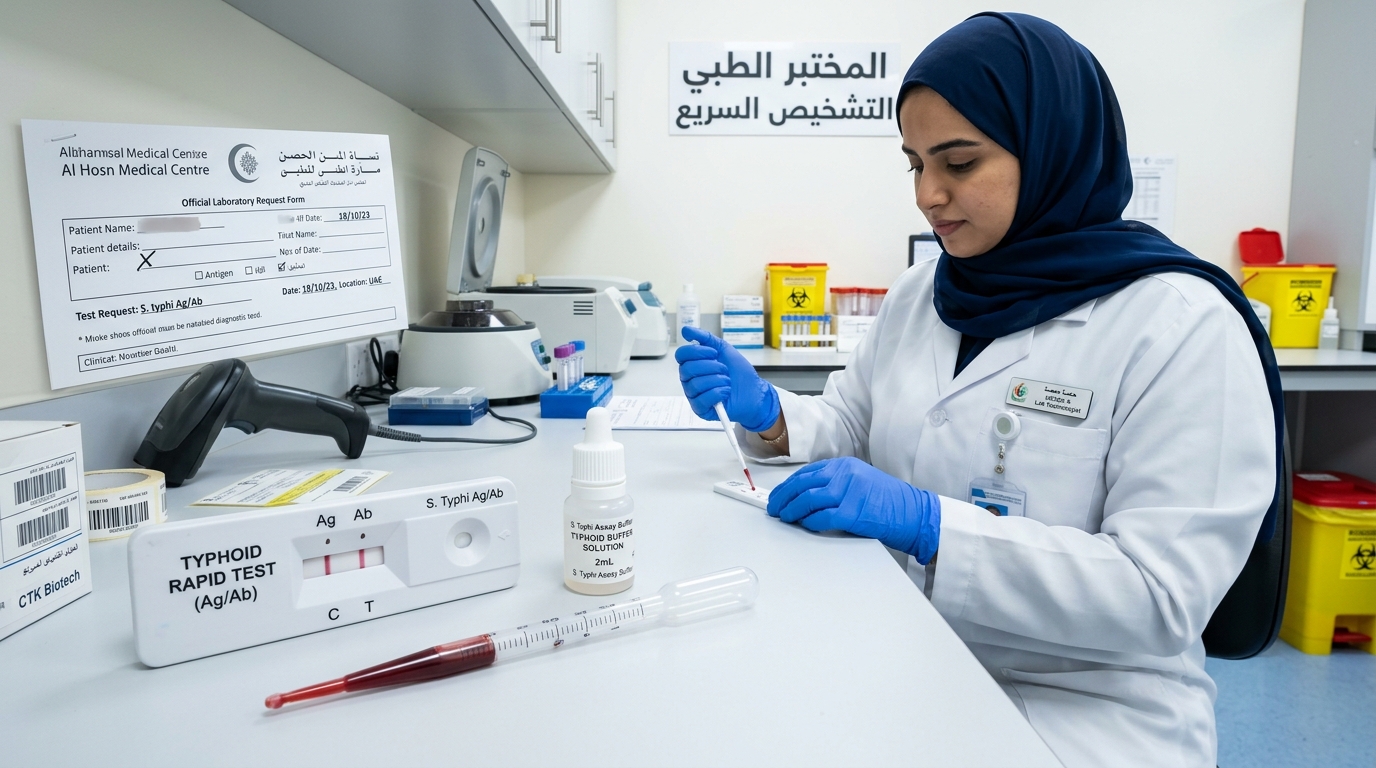
In international transit hubs like Dubai and across the Emirates, clinicians frequently evaluate returning travelers from South Asia, Southeast Asia, and Sub-Saharan Africa who present with sustained step-ladder fevers, relative bradycardia (Faget’s sign), and constitutional exhaustion. Because delayed treatment with appropriate antibiotics carries up to a 10% to 20% mortality rate from ileal ulceration and sepsis, rapid diagnostic triaging is essential. Utilizing validated point-of-care gastrointestinal rapid test kits provides immediate actionable clarity at the initial point of consultation.
Pathogen Biology: The Invasive Nature of Salmonella Typhi
Unlike non-typhoidal Salmonella species that cause self-limiting localized gastroenteritis and watery diarrhea, Salmonella Typhi is a strictly human-adapted systemic pathogen:
- Invasion of Peyer’s Patches: Following ingestion of contaminated food or water, S. Typhi invades the specialized microfold (M) cells of the terminal ileum Peyer’s patches, surviving within host intestinal macrophages.
- Reticuloendothelial Sequestration: The bacteria travel through mesenteric lymph nodes into the bloodstream (primary transient bacteremia), multiplying within liver Kupffer cells, spleen, and bone marrow during an asymptomatic 7 to 14 day incubation phase.
- Secondary Sustained Bacteremia: Following intracellular amplification, bacteria rupture into the bloodstream in massive numbers, triggering sustained high fevers, toxemia, and secondary gallbladder and intestinal seeding.
How the Rapid Antigen Test Works: Target Detection
Point-of-care immunochromatographic cassettes utilize specific biochemical targets to diagnose enteric fever:
- LPS O9 and O12 Antigens: High-affinity monoclonal antibodies on the test membrane capture circulating somatic lipopolysaccharide O-antigens shed directly by circulating bacteria during early acute bacteremia.
- Specific 50 kDa Outer Membrane Protein (OMP): Newer generation rapid tests detect antibodies or antigens specific to the outer membrane protein of S. Typhi, significantly reducing cross-reactions with non-typhoidal salmonellae and other Enterobacterales.
- Dual Antigen / Antibody Detection (IgM & IgG): Advanced combo cassettes simultaneously detect IgM (indicating acute early infection within days 4 to 7 of fever) and IgG (indicating past infection or convalescent phase).
Diagnostic Comparison: Rapid Test vs. Blood Culture vs. Widal Test
Understanding the strengths, limitations, and time horizons of the three primary typhoid diagnostics is fundamental for clinical practice:
| Diagnostic Modality | Gold Standard Status | Turnaround Time | Sensitivity Across Illness Stages | Diagnostic Specificity & Limitations |
|---|---|---|---|---|
| Automated Blood Culture | Clinical Gold Standard | 48 to 96 hours | 60% to 80% during Week 1; drops below 30% after prior antibiotic use | 100% specific; isolates viable organism and provides antibiotic susceptibility (MIC) |
| Typhoid Rapid Test (Ag/Ab) | Rapid Bedside Triaging | 10 to 15 minutes | 75% to 90% in acute phase (Days 3 to 14 of fever) | 85% to 95% specific; unaffected by prior antibiotics if targeting antigen; rapid POCT |
| Widal Agglutination Test | Obsolete / Historical | 24 hours | Poor (requires acute & convalescent paired sera 14 days apart) | Very Low (frequent false positives from malaria, dengue, enteroviruses, prior vaccination) |
| Bone Marrow Culture | Definitive Reference | 48 to 72 hours | >90% sensitive (even after days of antibiotic therapy) | 100% specific; invasive surgical aspirate, reserved for complex refractory cases |
Why the Widal Test is No Longer Recommended by International Guidelines
Introduced in 1896, the Widal tube agglutination test measures agglutinating antibodies against S. Typhi O (somatic) and H (flagellar) antigens. Modern clinical microbiology guidelines from the WHO and CDC strongly discourage relying on single acute Widal titers:
- High Cross-Reactivity: The O and H antigens cross-react extensively with antibodies from other common infections, including malaria, dengue fever, non-typhoidal Salmonella gastroenteritis, infectious mononucleosis, and autoimmune rheumatologic conditions.
- Anamnestic Reactions: Any past exposure to Salmonella or prior typhoid vaccination leaves long-lasting immunological memory titers that flare nonspecifically during unrelated acute viral fevers, leading to erroneous diagnoses of “typhoid.”
- Mandatory Paired Sera Requirement: A valid Widal diagnosis requires demonstrating a four-fold rise in antibody titer between day 5 and day 18 of fever—a delay that is clinically useless when acute treatment must be initiated immediately.
Clinical Protocol: Interpreting Rapid Test Results
When evaluating a patient with suspected enteric fever:
- IgM Positive / IgG Negative: Indicates early acute typhoid fever (typically Days 4 to 10 of illness). Initiate targeted antimicrobial therapy immediately and collect blood cultures prior to the first antibiotic dose.
- IgM Positive / IgG Positive: Indicates acute-on-convalescent typhoid fever (typically Week 2 to 3 of illness). Patient requires full antibiotic treatment course.
- IgG Positive / IgM Negative: Suggests past exposure, previous vaccination, or historical recovery. Does not explain current acute fever unless clinical signs strongly indicate relapse.
- Negative Rapid Test: If fever has lasted fewer than 3 days, repeat testing at Day 5 to 7 or perform automated blood culture and multiplex molecular panels. Point-of-care triaging with certified diagnostic rapid test kits ensures rapid clinical decision support.
Frequently Asked Questions (FAQs)
Can a rapid test replace a blood culture for typhoid?
No. Blood culture remains the gold standard because it isolates the living bacteria and provides essential antibiotic susceptibility profiles (especially critical given the emergence of extensively drug-resistant XDR typhoid strains). However, the rapid test provides an immediate 15-minute diagnosis that guides lifesaving early therapy while blood cultures incubate.
Why do doctors avoid the Widal test today?
The Widal test has a notoriously high false-positive rate. It cross-reacts with antibodies produced during common infections like malaria, dengue, and previous typhoid vaccines, frequently leading to misdiagnosis and inappropriate antibiotic therapy.
What are the classic symptoms of typhoid fever?
Classic typhoid symptoms include sustained step-ladder fever rising daily, severe frontal headache, dry cough, abdominal pain, relative bradycardia (slow heart rate despite high fever), constipation in early stages, and sometimes faint pink spots (“rose spots”) on the trunk.
Scientific References & Clinical Guidelines
- World Health Organization (WHO). Guidelines for the Diagnosis, Treatment, and Prevention of Typhoid Fever. WHO Guidelines. 2019; Geneva, Switzerland.
- Clinical Infectious Diseases. Current Diagnostics for Enteric Fever: A Critical Appraisal of Blood Culture, Rapid Tests, and Molecular Assays. Clin Infect Dis. 2019;68(Suppl 1):S4-S11.
- Lancet Infectious Diseases. Diagnostic Accuracy of Rapid Diagnostic Tests for Typhoid Fever: A Systematic Review and Meta-Analysis. Lancet Infect Dis. 2021;21(3):395-406.