
Typhoid IgG IgM Rapid Test: What Does It Detect? Salmonella Typhi Lipopolysaccharide (LPS), Acute vs Convalescent Antibodies & Clinical Interpretation
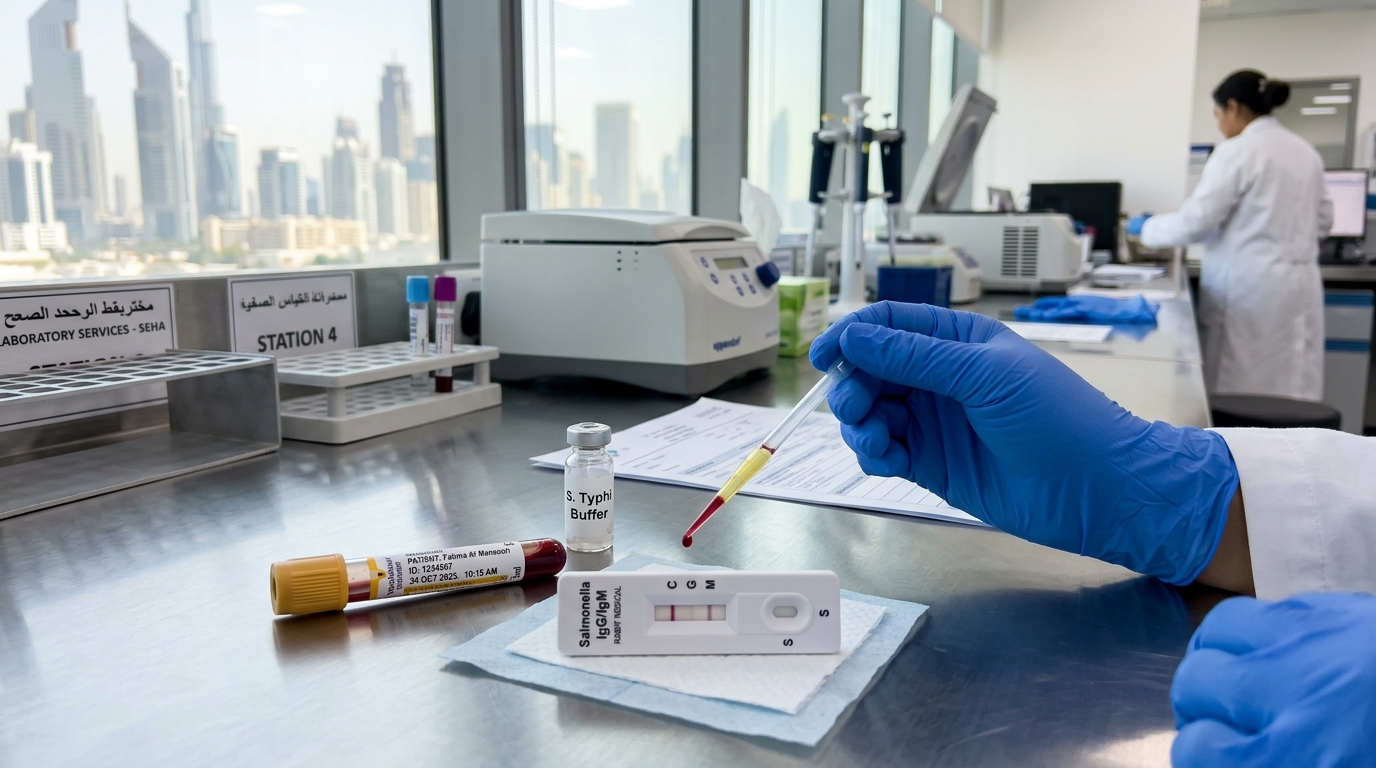
In cosmopolitan transit hubs across Dubai, Abu Dhabi, and Sharjah, travel medicine physicians regularly manage patients presenting with prolonged high-grade fever following visits to endemic regions across South Asia, Africa, and Southeast Asia. Timely differentiation of enteric fever from malaria, dengue, or acute viral gastroenteritis is vital to prevent intestinal perforation or septic shock. Utilizing certified advanced gastrointestinal rapid test kits in UAE equips healthcare providers with rapid, sensitive diagnostic confirmation from a single drop of whole blood or serum.
Pathophysiology: Salmonella Typhi Antigenic Targets
Salmonella enterica serotype Typhi is an invasive, human-restricted pathogen acquired through food or water contaminated with feces. Upon traversing intestinal microfold (M) cells, the bacteria replicate within mesenteric reticuloendothelial macrophages before seeding the bloodstream:
- Somatic Lipopolysaccharide (O-Antigen / LPS): The outer cell wall endotoxin responsible for triggering intense systemic inflammatory cascades and primary host antibody generation.
- Flagellar Protein (H-Antigen): The motile protein subunits that stimulate robust, long-lasting immunological responses.
- Capsular Polysaccharide (Vi-Antigen): A virulence capsule that shields the bacterium against complement-mediated lysis and neutrophil phagocytosis.
- Recombinant Outer Membrane Proteins (OMPs): Specific protein markers embedded in modern rapid test strips that eliminate false-positive cross-reactivity with non-typhoidal Salmonella species.
What Does the Typhoid IgG/IgM Rapid Test Detect?
Modern chromatographic cassettes detect human serum antibodies produced in response to Salmonella Typhi infection, resolving two distinct clinical phases:
| Antibody Fraction | Biological Appearance | Peak Serum Titer | Clinical Diagnostic Meaning |
|---|---|---|---|
| Typhoid IgM Positive | Days 3 to 7 of febrile illness | Week 2 of infection | Current, Acute Enteric Fever; mandates immediate targeted antibiotic therapy |
| Typhoid IgG Positive (IgM Negative) | Week 2 to 3 onward | Month 2 to 3 (Persists for years) | Past Infection, Memory Immunity, or Prior Vaccination; not indicative of acute disease |
| Both IgM & IgG Positive | Late Week 2 to Week 3 | Subacute phase | Active Subacute Infection or Reinfection; clinical treatment indicated |
| Both IgM & IgG Negative | Within first 48 to 72 hours of fever | N/A | Non-reactive; if clinical suspicion remains high, repeat in 48 hours or order blood cultures |
Mechanics of the Rapid Immunochromatographic Assay
The rapid test utilizes an antigen-coated nitrocellulose membrane arranged in a multi-band format:
- Sample Addition: Capillary whole blood, serum, or plasma (10 to 20 µL) is added into the specimen well, followed by two drops of running assay buffer.
- Conjugate Binding: Colloidal gold-conjugated anti-human IgM and anti-human IgG antibodies bind the corresponding human immunoglobulins present in the specimen.
- Chromatographic Migration: The mixture migrates along the membrane via capillary action toward the diagnostic test bands.
- Test Band Resolution:
- T1 Line (IgM): Contains immobilized S. Typhi specific recombinant antigens that capture gold-labeled anti-human IgM complexes, producing a pink-to-red band.
- T2 Line (IgG): Contains immobilized S. Typhi antigens that capture gold-labeled anti-human IgG complexes.
- Control Verification (C Line): A procedural control line binds excess gold conjugate, confirming liquid transit, membrane wicking, and reagent validity.
Rapid IgG/IgM Test vs. Archaic Widal Agglutination
For decades, the tube or slide Widal test was the primary serological tool for enteric fever. However, modern clinical guidelines strongly favor rapid lateral flow immunoassays over Widal testing due to severe diagnostic limitations of the latter:
| Comparative Parameter | Modern Typhoid IgG/IgM Rapid Test | Traditional Widal Agglutination Test |
|---|---|---|
| Turnaround Time | 15 Minutes (Bedside POCT) | 18 to 24 Hours (Incubation required) |
| Cross-Reactivity | Minimal (Purified recombinant OMP antigens) | High (Cross-reacts with Malaria, Dengue, Non-typhoidal Salmonella) |
| Early Detection (Week 1) | Sensitive IgM detection from Day 4 | Poor (Requires paired acute & convalescent 4-fold rise) |
| Ease of Interpretation | Clear qualitative visual bands | Subjective titer interpretation; endemic baseline titers confound results |
| Sample Type | Fingerstick whole blood, serum, plasma | Venous serum only |
Clinical Triage & Confirmatory Microbiology in UAE Hospitals
While rapid serology provides immediate triage data, accredited hospitals across the UAE integrate rapid testing into a broader microbiology protocol:
- Blood Culture (Gold Standard): Must be collected prior to antimicrobial initiation. Blood cultures achieve 60% to 80% sensitivity during the first week of illness when bacterial bacteremia is highest.
- Stool & Urine Cultures: Become positive during the second and third weeks of infection as bacterial shedding through biliary secretion peaks.
- Antimicrobial Resistance Surveillance: Due to global surges in Extensively Drug-Resistant (XDR) S. Typhi resistant to fluoroquinolones, cephalosporins, and macrolides, blood culture isolates undergo automated phenotypic susceptibility testing to guide Azithromycin, Ceftriaxone, or Carbapenem therapy.
Frequently Asked Questions (FAQ)
Can the typhoid rapid test be positive after typhoid vaccination?
Yes. Individuals who have received the injectable Vi polysaccharide typhoid vaccine or oral live-attenuated Ty21a vaccine within the previous 12 to 24 months may test positive on the IgG band due to vaccine-induced humoral memory antibodies. However, vaccine recipients typically remain IgM-negative in the absence of acute infection.
What should be done if the test is negative but fever persists for 7 days?
If clinical suspicion of enteric fever is strong, a single negative test during early illness should not rule out the diagnosis. Clinicians should repeat the rapid test 48 hours later, draw repeat aerobic blood cultures, and screen for malaria parasites, Dengue NS1 antigen, and respiratory viral pathogens.
Is fasting required before taking a typhoid rapid blood test?
No fasting is required. The test measures circulating immunoglobulin proteins which are unaffected by dietary intake. Testing can be performed immediately upon patient presentation at any time of day.
Scientific References & Authoritative Clinical Guidelines
- World Health Organization (WHO). Typhoid Fever: Global Surveillance, Rapid Diagnostics, and Immunization Guidelines. WHO Fact Sheets, Geneva, 2024.
- Centers for Disease Control and Prevention (CDC). Typhoid and Paratyphoid Fever: Clinical Guidance and Diagnostic Testing Algorithms. CDC Guidelines, 2024.
- Dubai Health Authority (DHA). Diagnostic and Management Standards for Acute Febrile Illnesses and Travel-Related Infectious Diseases. UAE Health Authority, 2024.