
Urethritis Testing Options: Gonococcal vs NGU, Multiplex Real-Time PCR, Urine vs Swabs & Clinical Diagnostic SOPs
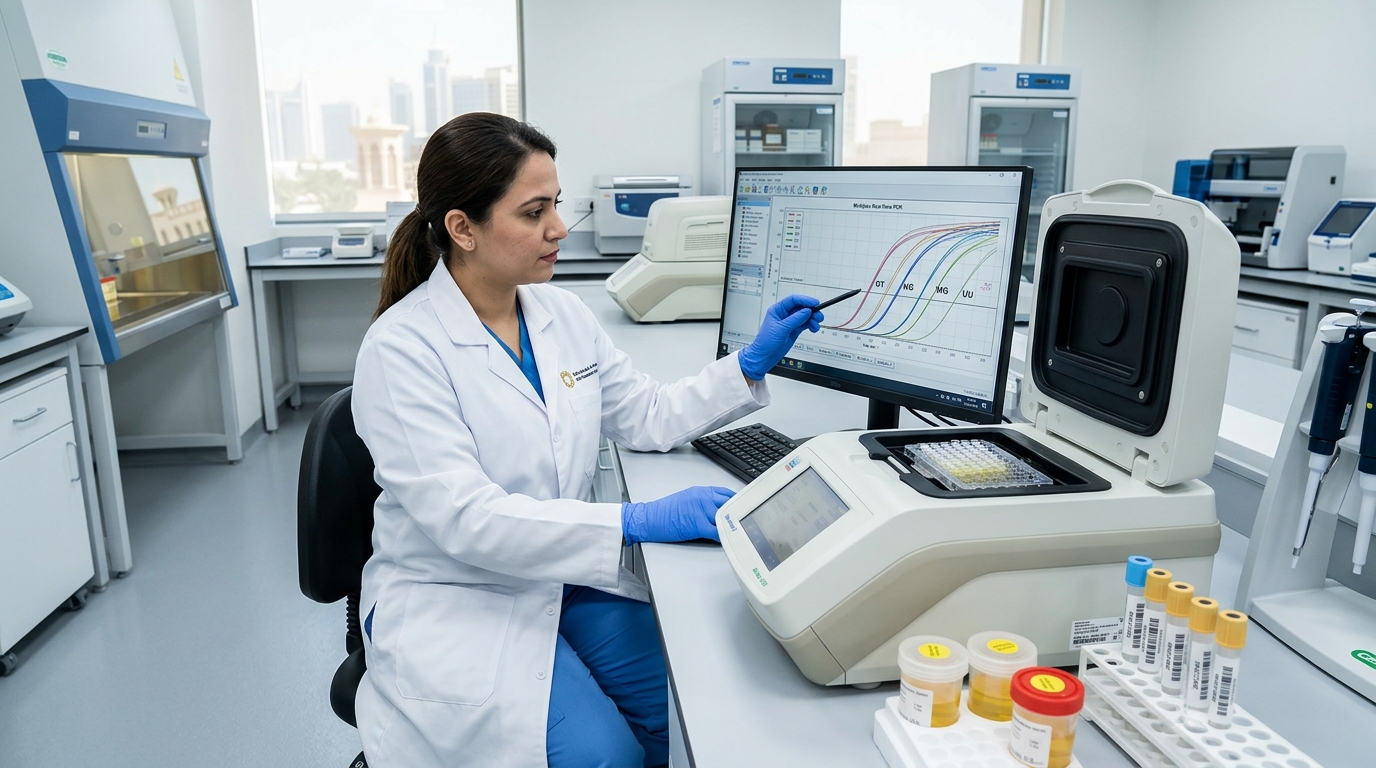
Throughout Dubai, Abu Dhabi, and across the UAE, men experiencing acute urethral burning or unexpected discharge often delay medical evaluation due to stigma or fear of painful swabbing procedures. Modern clinical diagnostic advances have revolutionized sexual healthcare, making testing entirely pain-free through automated molecular urine assays. Scheduling comprehensive confidential urogenital test packages in Dubai provides rapid, multi-pathogen identification, preventing chronic complications such as epididymitis, urethral strictures, and secondary subfertility.
Etiological Spectrum: Gonococcal vs. Non-Gonococcal Urethritis
Accurate clinical management hinges on distinguishing the primary causative pathogens driving urethral inflammation:
| Etiological Classification | Primary Causative Pathogen | Clinical Presentation Characteristics | Prevalence Rate (%) |
|---|---|---|---|
| Gonococcal Urethritis (GU) | Neisseria gonorrhoeae (Gram-negative diplococci) | Profuse, thick, yellow-green purulent discharge; severe dysuria; short incubation (2 to 5 days) | 20% to 30% of acute cases |
| Non-Gonococcal Urethritis (NGU) | Chlamydia trachomatis (Serovars D through K) | Scant, clear to white mucoid discharge; mild-to-moderate dysuria; longer incubation (1 to 3 weeks) | 30% to 45% of NGU cases |
| Non-Gonococcal Urethritis (NGU) | Mycoplasma genitalium | Persistent or recurrent urethritis; high rates of azithromycin treatment failure | 15% to 25% of NGU cases |
| Non-Gonococcal Urethritis (NGU) | Ureaplasma urealyticum & parvum | Low-grade chronic urethral irritation or asymptomatic carriage | 10% to 15% of cases |
| Non-Gonococcal Urethritis (NGU) | Trichomonas vaginalis & HSV (Herpes Simplex) | Watery discharge, severe dysuria, external meatal ulcerations (HSV) | 2% to 5% of cases |
Comprehensive Urethritis Testing Options
Clinicians utilize four primary diagnostic modalities to evaluate urethritis, each offering distinct advantages:
| Diagnostic Modality | Specimen Required | Clinical Sensitivity | Diagnostic Utility & Limitations |
|---|---|---|---|
| Multiplex Real-Time PCR (NAAT) | First-catch urine (First 20–30 mL) | >98% to 100% | Gold Standard; detects Gonorrhea, Chlamydia, M. genitalium, and macrolide resistance in single run |
| Gram Stain Microscopy | Urethral discharge smear | 95% for Gonorrhea; poor for NGU | Immediate point-of-care confirmation of Gram-negative intracellular diplococci (GNID); requires active discharge |
| Bacterial Culture & AST | Urethral swab on Thayer-Martin agar | 60% to 80% (Fastidious organism) | Mandatory for phenotypic antimicrobial susceptibility testing in suspected cephalosporin-resistant gonorrhea |
| Urinalysis (Leukocyte Esterase) | Midstream or random urine | Non-specific screening | Detects pyuria (>10 WBC/HPF); confirms presence of inflammation but cannot identify specific organism |
First-Catch Urine vs. Urethral Swab: The Modern Standard
Historical medical practice required inserting a Dacron or calcium alginate swab 2 to 4 cm into the male urethra—a painful experience that caused significant patient avoidance. Modern molecular guidelines have established that first-catch urine is analytically superior or equivalent to urethral swabbing for nucleic acid amplification:
- The First-Catch Urine Protocol: The patient must collect the initial 20 to 30 mL stream of urine (the “first catch”), which washes shed urethral epithelial cells and associated pathogens directly into the collection cup. Collecting midstream urine dilutes the sample and significantly lowers diagnostic sensitivity.
- The Critical Holding Time: Patients must not void their bladder for at least 1 to 2 hours prior to urine collection. Urinating immediately before the test flushes mucosal pathogens, leading to false-negative results.
The Emerging Threat: Mycoplasma genitalium and Macrolide Resistance
A critical limitation of outdated empiric urethritis therapy is the emergence of Mycoplasma genitalium. Lacking a bacterial peptidoglycan cell wall, M. genitalium is intrinsically resistant to beta-lactam antibiotics (penicillins and cephalosporins). Furthermore, widespread use of single-dose 1-gram Azithromycin has selected for 23S rRNA point mutations conferring over 60% to 80% macrolide resistance in urban centers.
Contemporary molecular panels performed in accredited Dubai laboratories incorporate reflex macrolide resistance mutation testing:
- Macrolide-Susceptible Strains: Treated with sequential Doxycycline (100 mg BID for 7 days) followed by high-dose Azithromycin.
- Macrolide-Resistant Strains: Treated with Doxycycline pre-treatment followed by Moxifloxacin (400 mg once daily for 7 days) to target topoisomerase IV and DNA gyrase.
Step-by-Step Clinical Diagnostic Workflow
UAE clinical protocols follow a structured algorithmic approach upon patient presentation:
- Clinical History & Exam: Assess incubation timeline, discharge appearance, sexual exposure history, and inspect meatus for lesions or ulcerations.
- Order First-Catch Multiplex PCR Panel: Cover N. gonorrhoeae, C. trachomatis, M. genitalium, and T. vaginalis.
- Empiric Therapy (If Patient is Severely Symptomatic): If immediate Gram stain confirms diplococci, initiate Ceftriaxone 500 mg IM. If non-gonococcal, administer Doxycycline 100 mg BID for 7 days while awaiting PCR results.
- Partner Notification: All sexual partners within the preceding 60 days must be notified, tested, and treated to prevent reinfection.
- Test of Cure (TOC): Mandatory for M. genitalium at 3 to 4 weeks post-treatment, and for Pharyngeal/Rectal Gonorrhea at 14 days.
Frequently Asked Questions (FAQ)
Can urethritis be caused by non-infectious factors?
Yes. Non-infectious urethritis accounts for 5% to 10% of cases and can be caused by chemical irritation from soaps, lubricants, or spermicides, vigorous sexual intercourse or masturbation, catheterization trauma, or chronic pelvic floor dysfunction.
How long after exposure can a PCR test detect urethritis?
Multiplex PCR can detect Neisseria gonorrhoeae as early as 48 to 72 hours post-exposure, while Chlamydia trachomatis and Mycoplasma genitalium typically require 5 to 14 days to reach detectable bacterial loads in urine.
Why did my symptoms return after finishing antibiotics?
Recurrent or persistent urethritis occurs most frequently due to: (1) Infection with macrolide-resistant Mycoplasma genitalium, (2) Reinfection from an untreated sexual partner, or (3) Infection with uncommon pathogens such as Trichomonas vaginalis or Ureaplasma requiring alternate antimicrobial classes.
Scientific References & Authoritative Clinical Guidelines
- Centers for Disease Control and Prevention (CDC). Sexually Transmitted Infections Treatment Guidelines: Management of Urethritis in Men. MMWR Recommendations, 2024.
- International Union against Sexually Transmitted Infections (IUSTI). European Guideline on the Management of Non-Gonococcal Urethritis. IUSTI Guidelines, 2023.
- Dubai Health Authority (DHA). Diagnostic Standards for Sexually Transmitted Infections and Molecular Urogenital Panels. UAE Health Regulations, 2024.