
Vaginal Candidiasis Testing Options: Rapid Antigen Tests, Wet Mount Microscopy, Fungal Culture & Non-albicans Resistance
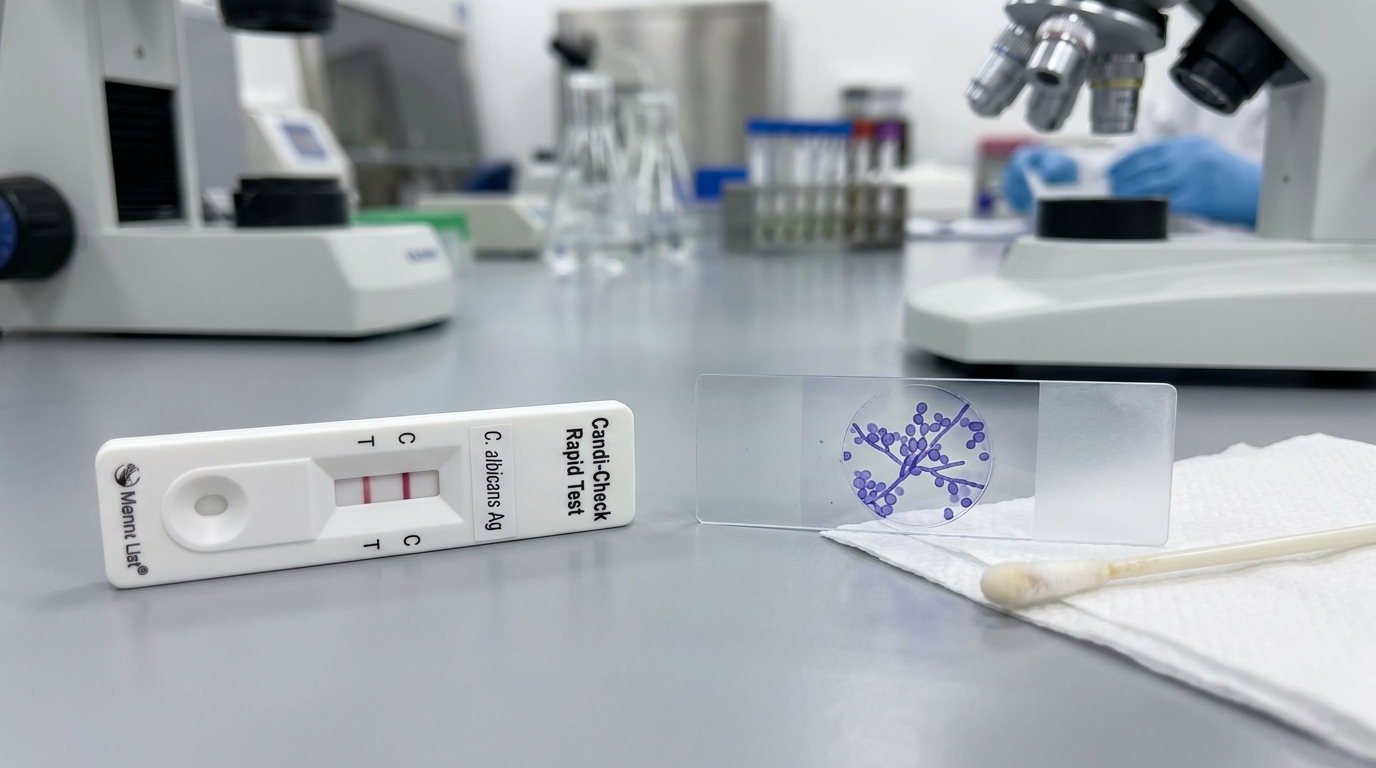
In women’s health clinics throughout Dubai, Abu Dhabi, and Sharjah, recurrent vaginitis represents one of the most frequent outpatient complaints. The warm, humid climate of the UAE, coupled with tight synthetic clothing, frequent antibiotics, and metabolic factors like diabetes, exacerbates fungal proliferation. Rather than guessing with repetitive over-the-counter creams, scheduling comprehensive confidential urogenital test packages in Dubai provides rapid, multi-pathogen confirmation, establishing precise fungal identification and preventing chronic recurrences.
Pathogen Speciation: Candida albicans vs. Non-albicans Species
Understanding fungal speciation is vital for clinical success because treatment pathways diverge fundamentally between species:
| Fungal Pathogen | Prevalence in Acute VVC (%) | Microscopic Appearance | Intrinsic Azole Resistance Profile |
|---|---|---|---|
| Candida albicans | 80% to 90% (Dominant Pathogen) | Budding blastospores, pseudohyphae, and true germ tubes | Highly Susceptible to Azoles (Fluconazole, Clotrimazole, Miconazole) |
| Candida glabrata | 5% to 10% (Rising in Recurrent VVC) | Small blastospores only; NO pseudohyphae formed | High Intrinsic Resistance to Fluconazole; requires Boric Acid or Amphotericin B |
| Candida tropicalis & parapsilosis | 2% to 5% | Extensive pseudohyphae with blastospores | Variable azole susceptibility; potential biofilm formation |
| Candida krusei | <1% | Elongated blastospores | Intrinsically Resistant to Fluconazole; requires Voriconazole or Echinocandins |
Comprehensive Vaginal Candidiasis Testing Options
Clinicians utilize four primary diagnostic methodologies to evaluate suspected candidiasis:
| Diagnostic Modality | Turnaround Time | Clinical Sensitivity | Primary Advantages & Clinical Role |
|---|---|---|---|
| Rapid Antigen Lateral Flow Test (POCT) | 10 to 15 Minutes | 88% to 95% | Fastest Bedside Confirmation; detects Candida cell wall antigens; no microscope needed |
| 10% KOH Wet Mount Microscopy | 5 to 10 Minutes | 50% to 70% (Operator-dependent) | Immediate in-office test; KOH dissolves host epithelial cells, revealing refractory pseudohyphae |
| Fungal Culture (Sabouraud Agar) | 48 to 72 Hours | >95% (Gold Standard for Speciation) | Essential for recurrent VVC; enables antifungal susceptibility testing (MICs) |
| Multiplex Vaginitis PCR Panel (NAAT) | 2 to 4 Hours | >98% | Simultaneously differentiates Candida species, Bacterial Vaginosis, and Trichomonas |
Mechanics of the Rapid Candida Antigen Test
Modern point-of-care rapid antigen test cassettes deliver molecular-grade specificity without requiring complex laboratory instrumentation:
- Swab Collection: A sterile Dacron swab collects vaginal discharge from the mid-to-lower lateral vaginal wall.
- Antigen Extraction: The swab is agitated in an extraction buffer that solubilizes Candida cell wall mannan and protein antigens.
- Capillary Chromatography: Fluid is delivered into the sample well, migrating across a membrane impregnated with gold-labeled monoclonal antibodies.
- Dual Line Resolution: A distinct test line (T) binds immobilized anti-Candida capture antibodies, forming a visible pink/red line within 10 minutes if fungal antigen exceeds analytical thresholds.
- Procedural Verification (C Line): Confirms valid buffer wicking and reagent stability.
Diagnostic Pitfall: Vaginal pH as a Critical Differential Tool
Measuring vaginal secretions with narrow-range pH paper (pH 3.5 to 6.0) is a crucial, cost-effective clinical triage step:
- Normal Vaginal pH (3.8 to 4.5): Suggestive of Uncomplicated Candidiasis. Unlike bacterial vaginosis and trichomoniasis, Candida thrives in a naturally acidic environment dominated by protective Lactobacillus species.
- Elevated Vaginal pH (>4.5): Argues AGAINST Pure Candidiasis. An elevated pH strongly indicates Bacterial Vaginosis (BV) or Trichomonas vaginalis infection, or a mixed polymicrobial co-infection.
Protocol for Recurrent Vulvovaginal Candidiasis (RVVC)
Recurrent VVC is defined as four or more documented episodes within a 12-month period. Managing RVVC requires a systematic diagnostic escalation:
- Mandatory Fungal Culture & Speciation: Empiric treatment without culture is contraindicated. Fungal cultures on CHROMagar or Sabouraud dextrose agar identify whether Candida glabrata or krusei is responsible for recurrent azole failure.
- Screening for Underlying Systemic Precipitants: Fasting blood glucose and HbA1c to screen for undiagnosed type 2 diabetes mellitus, reviewing antibiotic and corticosteroid usage, and screening for HIV in severe intractable cases.
- Suppressive Maintenance Therapy: Induction with oral Fluconazole (150 mg every 72 hours for 3 doses) followed by weekly maintenance Fluconazole (150 mg once weekly) for 6 consecutive months.
Targeted Antifungal Pharmacotherapy for Non-albicans Strains
Because non-albicans species demonstrate diminished or absent susceptibility to standard oral fluconazole, specific alternative antimycotic regimens are indicated:
- Candida glabrata Treatment Regimens: First-line therapy consists of intravaginal Boric Acid gelatin capsules (600 mg daily at bedtime for 14 to 21 days), achieving clinical cure rates of 65% to 75%. In refractory cases, compounded topical 17% Flucytosine cream or Nystatin suppositories (100,000 units daily for 14 days) are deployed.
- Candida krusei Treatment Regimens: Due to complete intrinsic resistance to fluconazole, patients require topical Clotrimazole 1% cream, Terconazole 0.8% suppository, or oral Voriconazole under specialist mycological supervision.
Pregnancy Considerations: Safety of Topical vs. Oral Azoles
Vaginal candidiasis is up to 3 times more frequent during pregnancy due to elevated circulating estrogen levels that increase glycogen content in the vaginal epithelium, providing an abundant nutrient source for yeast germination:
- Absolute Contraindication for Oral Fluconazole: Epidemiological studies have linked first-trimester oral fluconazole exposure to increased risks of spontaneous miscarriage and congenital cardiac malformations (tetralogy of Fallot). High-dose oral therapy is strictly contraindicated.
- Endorsed Treatment Protocol in Pregnancy: Only topical azole therapies administered for a full 7 consecutive days (e.g., Clotrimazole 1% vaginal cream or Miconazole 2% cream) are endorsed by international guidelines. Short 1-day or 3-day courses demonstrate unacceptable recurrence rates during pregnancy.
Frequently Asked Questions (FAQ)
Why did my over-the-counter yeast infection treatment fail?
Over-the-counter azole treatments fail for three primary reasons: (1) The underlying infection is actually Bacterial Vaginosis or Trichomoniasis (which mimics yeast symptoms but requires antibiotics), (2) The infection is caused by Candida glabrata, which is intrinsically resistant to fluconazole, or (3) Underlying unmanaged diabetes is continually fueling fungal regrowth.
Can a woman have Candida without any symptoms?
Yes. Candida albicans is a normal commensal organism found in the vaginal microbiome of 20% to 30% of healthy, asymptomatic women. Treatment is only indicated when clinical symptoms (itching, burning, erythema, abnormal discharge) and objective inflammation are present.
Does my male sexual partner need to be tested and treated?
Routine treatment of male sexual partners is not recommended by international guidelines because candidiasis is not classified as a sexually transmitted infection. However, if the male partner exhibits symptomatic balanitis (penile redness, itching, or rash), topical antifungal therapy is indicated.
Scientific References & Authoritative Clinical Guidelines
- Centers for Disease Control and Prevention (CDC). Sexually Transmitted Infections Treatment Guidelines: Vulvovaginal Candidiasis (VVC) Diagnosis and Management. MMWR, 2024.
- International Union against Sexually Transmitted Infections (IUSTI). European Guideline on the Management of Vulvovaginal Candidiasis. IUSTI Guidelines, 2023.
- Dubai Health Authority (DHA). Clinical Protocols for Gynecological Infections and Outpatient Vaginitis Diagnostic Panels. UAE Health Standards, 2024.