
What Does COVID-19 Antigen (Professional) Rapid Testing Detect—and What Can It Miss?
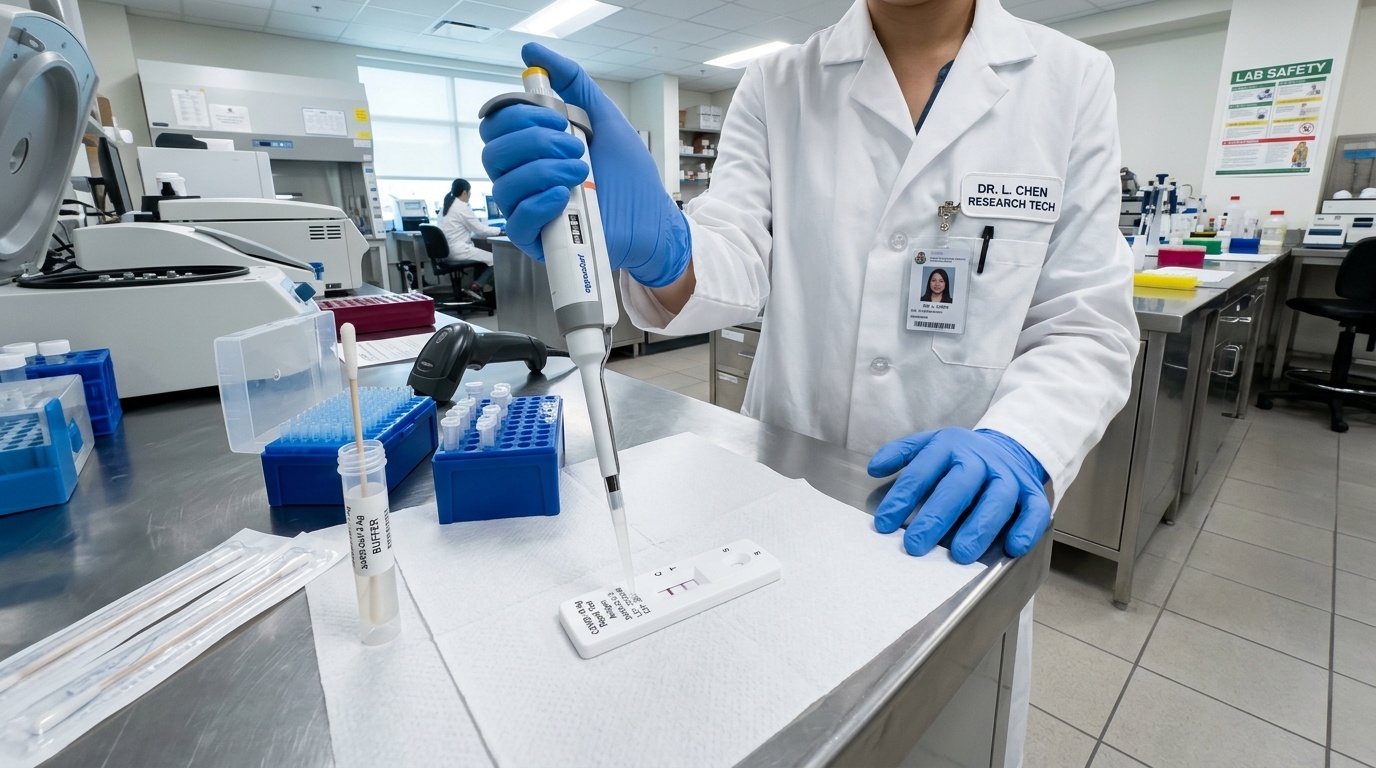
In acute respiratory triage, workplace screening, and hospital admission protocols across the UAE, rapid lateral flow chromatography represents a frontline diagnostic modality. However, clinicians, infection control officers, and procurement managers frequently evaluate: professional covid antigen rapid test what does it detect with precision, and under what clinical circumstances might a false-negative result occur? Healthcare facilities procuring verified respiratory rapid test kits for clinics must understand the analytical mechanisms that separate rapid protein detection from thermal amplification.
Target Protein Biology: Why the Nucleocapsid (N) Protein Matters
Unlike molecular Reverse Transcription Polymerase Chain Reaction (RT-PCR), which amplifies tiny segments of the viral genome, rapid antigen detection devices rely on immobilized monoclonal antibodies to bind physical viral proteins. Specifically, over 95% of professional lateral flow assays target the SARS-CoV-2 Nucleocapsid (N) protein rather than the surface Spike (S) glycoprotein.
This biochemical design offers two paramount diagnostic advantages:
- Extreme Structural Abundance: During active intracellular replication, infected respiratory epithelial cells produce approximately 1,000-fold more copies of the Nucleocapsid protein than Spike trimers, maximizing the optical signal on colloidal gold or fluorescent test lines.
- Evolutionary Conservation: The Spike protein undergoes frequent antigenic drift and selective mutation pressure (as seen across Omicron lineages). Conversely, the Nucleocapsid gene is comparatively stable, ensuring that professional antigen tests maintain analytical sensitivity across emerging variants without requiring redesign.
Analytical Sensitivity and Cycle Threshold (Ct) Benchmarks
The diagnostic performance of professional COVID-19 antigen tests is directly coupled to patient viral burden, which is inversely quantified by RT-PCR Cycle Threshold (Ct) values.
| PCR Cycle Threshold (Ct) | Estimated Viral Load (copies/mL) | Professional Antigen Sensitivity | Clinical Transmissibility Status |
|---|---|---|---|
| Ct < 20 (Ultra High) | > 100,000,000 copies/mL | 98.5% – 99.8% | Highly contagious, peak acute infection (Days 1–4 of symptoms) |
| Ct 20 – 25 (High) | 1,000,000 – 10,000,000 copies/mL | 92.0% – 96.5% | Active viral replication, high secondary transmission risk |
| Ct 25 – 30 (Moderate) | 10,000 – 100,000 copies/mL | 72.0% – 84.0% | Early onset or late clearance phase; moderate shedding |
| Ct > 30 (Low / Trace) | < 5,000 copies/mL | 25.0% – 45.0% | Non-infectious post-infection shedding or very early incubation |
What Professional Antigen Testing Can Miss: Diagnostic Limitations
While exceptionally valuable for rapid containment, professional antigen tests have distinct analytical vulnerabilities that clinicians must manage through serial testing or reflex confirmatory molecular assays:
1. The Incubation Window (Days 0 to 2 Post-Exposure)
In the earliest 24 to 48 hours following exposure, viral replication within the nasopharyngeal mucosa has not yet breached the analytical Limit of Detection (LoD), typically between $10^2$ to $10^3$ $TCID_{50}/mL$. Testing an asymptomatic individual during this period yields high false-negative rates.
2. Late-Stage Convalescence
Beyond day 7 to 10 of symptom onset, mucosal immunoglobulin-A (IgA) and systemic antibodies bind to exposed viral proteins, masking antigenic epitopes from lateral flow detection even if trace genomic fragments remain detectable on RT-PCR.
3. Inadequate Pre-Analytical Specimen Collection
Unlike self-swabbing, professional testing requires trained sampling technique. A shallow nasal swab that fails to contact the posterior nasopharyngeal mucosa or turbinates will harvest insufficient epithelial cell volume, producing an artificially faint or absent test band.
Professional Use vs Self-Test Devices: Key Differences
Regulatory bodies such as the UAE Ministry of Health and Prevention (MOHAP) and the US FDA establish separate analytical and operational standards for point-of-care (POC) professional kits versus over-the-counter self-test devices:
- Higher Analytical Sensitivity: Professional assays utilize optimized high-affinity monoclonal conjugates and concentrated extraction lysis buffers, yielding lower limits of detection.
- Rigorous Specimen Collection: Professional kits often include flexible flocked nasopharyngeal swabs capable of reaching deep anatomical reservoirs inaccessible to rigid anterior nasal swabs.
- Quality Assurance Controls: Professional packages include external positive and negative lyophilized control swabs to verify kit integrity and operator proficiency before testing patient batches.
Laboratory Best Practices for Professional Rapid Screening
To ensure diagnostic precision and avoid invalid runs, clinical staff should enforce the following operational protocol:
- Reagent Equilibration: Allow test cassettes and extraction buffer vials to reach ambient room temperature (18°C–25°C) for at least 30 minutes prior to opening foil pouches. Cold reagents dramatically slow capillary flow rates.
- Extraction Incubation: Immerse the specimen swab into the extraction buffer tube, rotate firmly at least 10 times against the tube wall, and squeeze the flexible tube walls against the swab tip to extract maximum fluid volume.
- Strict Reading Window: Interpret results strictly at the manufacturer-specified time (typically 15 minutes). Reading before 15 minutes risks false negatives; reading after 20 to 30 minutes may cause ghost bands due to nonspecific evaporation drying.
Peer-Reviewed Clinical References
- World Health Organization (WHO). Antigen-detection in the diagnosis of SARS-CoV-2 infection: Interim guidance. WHO Guidelines, 2021.
- Peeling, R. W., et al. Diagnostics for COVID-19: moving from pandemic response to endemic management. The Lancet Microbe, 2022; 3(8): e605-e615.
- Dinnes, J., et al. Rapid, point-of-care antigen and molecular-based tests for diagnosis of SARS-CoV-2 infection. Cochrane Database of Systematic Reviews, 2022; Issue 7.