
What Does RSV Antigen Rapid Testing Detect—and What Can It Miss?
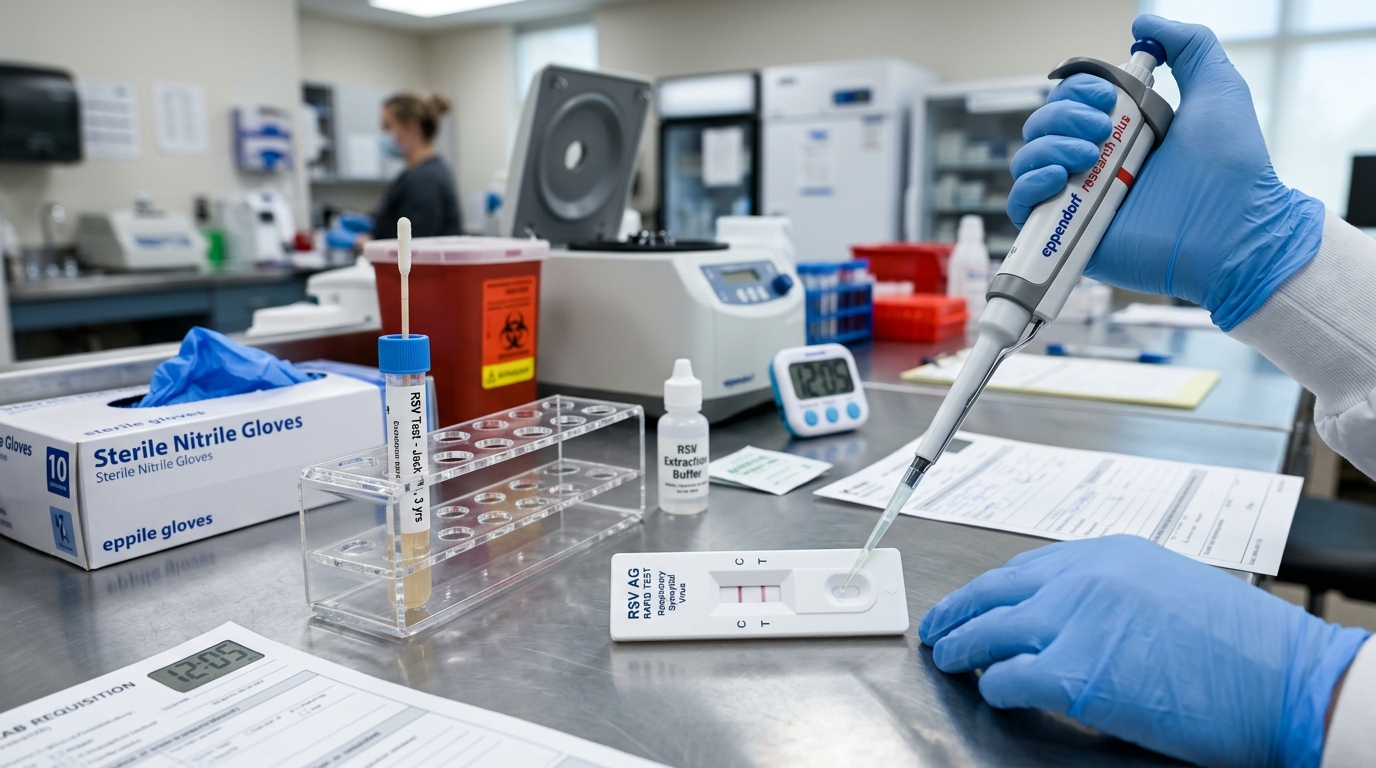
During the autumn and winter respiratory infection peaks across the UAE, emergency departments and pediatric clinics face heavy caseloads of wheezing infants and coughing children. Differentiating between RSV, seasonal influenza, and SARS-CoV-2 is critical for cohorting patients, avoiding unnecessary antibiotics, and providing targeted hydration support. Clinics stocking certified respiratory rapid test kits for clinics frequently rely on rapid RSV antigen cassettes, often run concurrently with COVID-19 and Influenza A+B combo rapid testing to achieve comprehensive triage within 15 minutes.
Target Antigens: The Fusion (F) and Major Nucleoprotein (N)
RSV is an enveloped, negative-sense, single-stranded RNA pneumovirus belonging to the family Pneumoviridae. Commercial point-of-care rapid tests employ immobilized gold-conjugated monoclonal antibodies directed against structural viral proteins:
- Fusion (F) Glycoprotein: A highly conserved surface spike protein essential for viral entry and syncytium formation. Because the F-protein is structurally homologous across both RSV Subtypes A and B, monoclonal antibodies targeting the F-glycoprotein provide broad dual-subtype detection.
- Nucleoprotein (N): An abundant internal capsid protein surrounding the genomic RNA core, providing high optical signal intensity during active intracellular lysis.
Analytical Sensitivity Benchmark: Rapid Antigen vs Molecular RT-PCR
The table below summarizes clinical diagnostic accuracy across different patient demographics:
| Patient Cohort | Typical Viral Load | Rapid Antigen Sensitivity | RT-PCR Sensitivity | Recommended Clinical Protocol |
|---|---|---|---|---|
| Infants (< 2 years) | Very High (> 10⁷ copies/mL) | 85% – 93% | 98% – 100% | Rapid antigen test positive is actionable; negative in severe distress reflex to PCR. |
| Children (2 to 5 years) | High (10⁵ – 10⁷ copies/mL) | 75% – 85% | 98% – 100% | Standard rapid testing suitable for outpatient triage and daycare return decisions. |
| Adults & Geriatrics (> 65) | Low to Moderate (< 10⁴ copies/mL) | 30% – 52% | 99% – 100% | A negative rapid antigen test NEVER rules out RSV; molecular multiplex PCR is mandatory. |
What RSV Antigen Rapid Testing Can Miss: Diagnostic Limitations
Medical providers and infection control specialists must account for specific analytical blind spots:
1. False Negatives in Adult Lower Respiratory Disease
In older adults, RSV frequently presents as exacerbation of Chronic Obstructive Pulmonary Disease (COPD) or congestive heart failure. Because the infection is largely sequestered in lower bronchial structures with minimal upper nasopharyngeal shedding, rapid swabs yield false-negative results in over half of cases.
2. Inappropriate Specimen Collection (Nasal Swab vs Nasopharyngeal Aspirate)
In pediatric patients, nasopharyngeal aspirates (NPA) or deep flocked nasopharyngeal swabs yield the highest viral cellular yield. A gentle anterior nasal swab collected by an anxious parent frequently misses the posterior epithelial reservoir, producing false-negative results.
3. Late-Stage Presentation (Beyond Day 7 of Illness)
While peak viral shedding occurs on days 2 to 4 of respiratory illness, patients presenting after a week of coughing experience declining mucosal antigen concentrations that fall below the test’s Limit of Detection (LoD).
Best Practices for Specimen Collection and Workflow
To maximize accuracy when performing point-of-care rapid testing in clinics:
- Use Flocked Swabs: Flocked nylon swabs release up to 90% of harvested cellular material into extraction buffer compared to standard cotton or Dacron swabs.
- Sufficient Dwell Time: Insert the swab into the posterior nasopharynx until resistance is met, rotate gently for 5 seconds to absorb secretions, and extract into buffer immediately.
- Prompt Result Interpretation: Read the cassette strictly between 15 and 20 minutes. Late readings past 30 minutes can display false evaporation lines.
Peer-Reviewed Clinical References
- Centers for Disease Control and Prevention (CDC). RSV Clinical Information and Diagnostic Testing Methods. CDC Respiratory Viruses Guide, 2024.
- Ralston, S. L., et al. Clinical Practice Guideline: The Diagnosis, Management, and Prevention of Bronchiolitis. Pediatrics, 2014; 134(5): e1474-e1502.
- Chartrand, C., et al. Diagnostic Accuracy of Rapid Antigen Detection Tests for Respiratory Syncytial Virus Infection: Systematic Review and Meta-analysis. Journal of Clinical Microbiology, 2015; 53(12): 3738-3749.