
When is Herpes PCR Swab Testing Indicated? Vesicle Unroofing Protocols, Viral Shedding Kinetics & Neonatal Prophylaxis
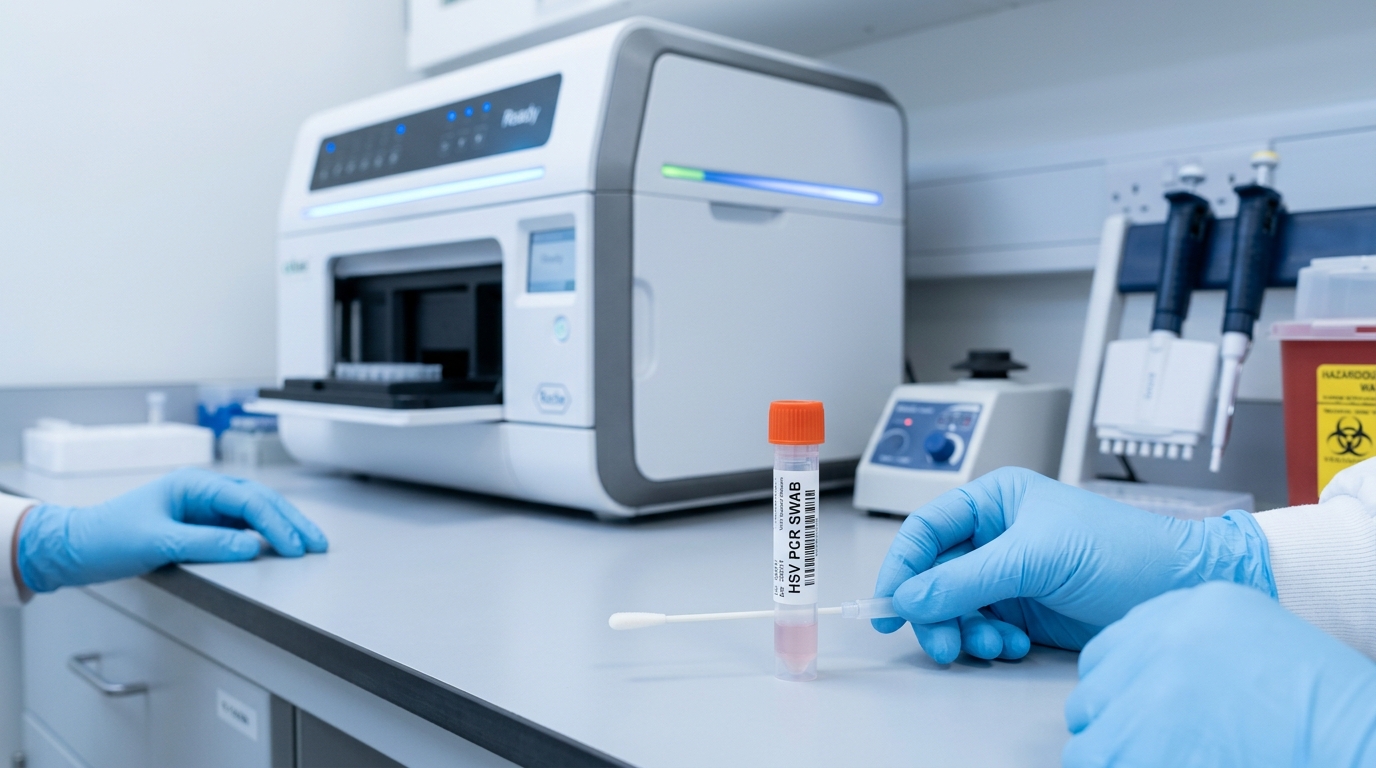
In high-standard medical facilities across Dubai, Abu Dhabi, and the wider UAE, patients presenting with acute genital ulcerations or unexplained perineal pain require rapid, confidential diagnostic differentiation. Booking comprehensive discrete sexual health and STI testing packages in Dubai ensures immediate access to multiplex viral PCR panels capable of distinguishing HSV-1, HSV-2, Syphilis, and Chancroid from a single non-invasive swab.
Diagnostic Superiority: Why PCR Has Replaced Viral Culture and Tzanck Smears
Historically, clinicians relied on viral cell culture or cytologic Tzanck smears to diagnose herpes. However, these legacy methods suffer from severe clinical limitations:
| Evaluation Parameter | Real-Time PCR (NAAT Swab) | Viral Cell Culture | Tzanck Smear Cytology |
|---|---|---|---|
| Clinical Sensitivity (Vesicular Phase) | >98% to 100% | 60% to 75% | 40% to 50% |
| Clinical Sensitivity (Crusted / Healing Phase) | >85% to 90% | <20% to 30% (Virions non-viable) | <15% (Inconclusive) |
| Turnaround Time | 2 to 4 Hours | 3 to 7 Days | 30 Minutes (Manual staining) |
| HSV-1 vs. HSV-2 Differentiation | Immediate, objective multiplex typing | Requires secondary immunofluorescence | Cannot differentiate (Identifies multinucleated giant cells only) |
| Transport Stability | High stability in Universal Transport Media (UTM) | Extreme loss of viability at ambient temperatures | Fixed on glass slide; fragile |
Core Clinical Indications: When Should a Herpes PCR Swab Be Ordered?
Real-time PCR swabbing is clinically indicated under specific evidence-based clinical presentations:
- Acute Mucocutaneous Ulcers or Vesicular Eruptions: Any patient presenting with classic single or grouped fluid-filled vesicles, pustules, or painful shallow erosions on the genitalia, perineum, perianal region, buttocks, thighs, or oral mucosa.
- Atypical Genital Presentations: Recurrent linear fissures, erythema, pruritic excoriations, or chronic vulvar/penile irritation lacking classic blisters. Up to 40% of genital herpes cases present atypically, frequently misdiagnosed as recurrent candidiasis, contact dermatitis, or balanitis.
- Third-Trimester Pregnancy Lesions: Pregnant women presenting with any suspicious genital lesion near labor. Rapid PCR confirmation within hours guides intrapartum management: detecting shedding mandates Cesarean delivery to prevent catastrophic neonatal herpes.
- Suspected Herpetic Whitlow or Herpes Gladiatorum: Painful vesicular lesions on digits (whitlow) in healthcare workers, dental staff, or children, and facial/neck clusters in contact sports athletes.
- Immunocompromised Host Ulcers: Chronic, non-healing, vegetative, or large necrotic ulcerations in HIV patients, organ transplant recipients, or oncology patients, including monitoring for thymidine kinase resistance mutations.
Step-by-Step Clinical Procedure: Vesicle Unroofing & Swab Collection SOP
The diagnostic accuracy of a PCR test directly depends on harvesting adequate viral DNA from the basal epithelial layer. Clinicians must follow a rigorous 5-stage standard operating procedure:
| Procedural Stage | Clinical Action | Technical Rationale |
|---|---|---|
| 1. Lesion Selection | Identify fresh, intact vesicles or freshly unroofed wet ulcers | Viral replication peaks during the first 48 to 72 hours; highest viral DNA copy numbers |
| 2. Vesicle Unroofing | Gently unroof an intact vesicle using a sterile 25-gauge needle tip or scalpel edge | Releases concentrated vesicular fluid containing millions of virions |
| 3. Swab Harvesting | Vigorously rub the base of the ulcer with a sterile flocked nylon or Dacron swab | HSV infects basal keratinocytes; vigorous scraping harvests infected cellular DNA, not just surface exudate |
| 4. Medium Inoculation | Place the swab immediately into Universal Viral Transport Medium (UTM / VTM) | Stabilizes viral DNA; prevents bacterial/fungal overgrowth |
| 5. Storage & Transport | Store at 2°C to 8°C; transport to laboratory within 24 to 48 hours | Maintains nucleic acid integrity prior to automated automated extraction |
Why Serology (Blood Test) Cannot Replace a Direct Lesion Swab
A widespread misconception is that an HSV blood test is interchangeable with a lesion swab. Clinical guidelines from the CDC and IUSTI strictly emphasize why blood tests are inadequate for acute symptoms:
- The 6- to 12-Week Seroconversion Window: When a patient develops a first-episode primary herpes outbreak, IgG antibodies take 6 to 12 weeks to become detectable in blood. Testing serum in the acute phase yields a false-negative result in over 70% of primary infections.
- Lack of Anatomical Specificity: Serum IgG tests only indicate that the patient was exposed to HSV at some point in their life. Because over 60% of adults carry oral HSV-1 antibodies from childhood, a positive blood test cannot confirm whether a genital lesion is caused by herpes. Only a PCR swab from the lesion proves causality.
Interpreting PCR Results & Cycle Threshold (Ct) Values
Modern quantitative real-time PCR platforms report both qualitative detection and Cycle Threshold (Ct) values:
- Low Ct Value (<25 cycles): Indicates high viral load. Classic for primary first-episode herpes, actively ruptured vesicles, or intense viral replication. High contagiousness.
- Moderate Ct Value (25 to 35 cycles): Typical for mild recurrent outbreaks or mid-stage ulcerations undergoing re-epithelialization.
- High Ct Value (>35 cycles): Low viral copy count. Frequently seen in late crusted lesions or asymptomatic subclinical viral shedding. Confirms presence of viral genome.
- Negative (Undetermined Ct): HSV DNA not detected. If the swab was collected from an old crusted lesion (>7 days old), false negatives can occur. If clinical suspicion remains high, repeat testing on subsequent outbreaks or check convalescent serology in 8 to 12 weeks.
Frequently Asked Questions (FAQ)
Does a negative herpes PCR swab completely rule out herpes?
A negative PCR swab from a fresh, wet blister virtually excludes active herpes. However, if the lesion was swabbed after it had completely scabbed and dried (beyond 5 to 7 days), or if topical antiviral cream was applied prior to swabbing, viral DNA levels may drop below the limit of detection.
Can a herpes PCR swab be performed on healed or crusted skin?
While PCR is far more sensitive than culture on crusted lesions, the diagnostic yield drops significantly once dry eschars form. If only crusts are present, the crust should be gently lifted and the moist base swabbed firmly.
Is swabbing painful for the patient?
Swabbing the base of an active genital ulcer causes brief, sharp discomfort for 2 to 3 seconds because nerve endings are exposed. Clinicians should reassure the patient and apply gentle, rapid technique.
Scientific References & Authoritative Clinical Guidelines
- Centers for Disease Control and Prevention (CDC). Sexually Transmitted Infections Treatment Guidelines: Laboratory Diagnosis of Genital Herpes. MMWR, 2024.
- International Union against Sexually Transmitted Infections (IUSTI). European Guideline for the Diagnosis and Management of Genital Herpes Simplex Virus. IUSTI, 2024.
- Dubai Health Authority (DHA). Diagnostic Standards for Sexually Transmitted Infections in Primary Care and Specialized Centers. UAE Health Regulations, 2024.