
When is Syphilis RPR Testing Indicated? Non-Treponemal Titers, Treatment Monitoring, Prozone Effect & Reverse Algorithm Workups
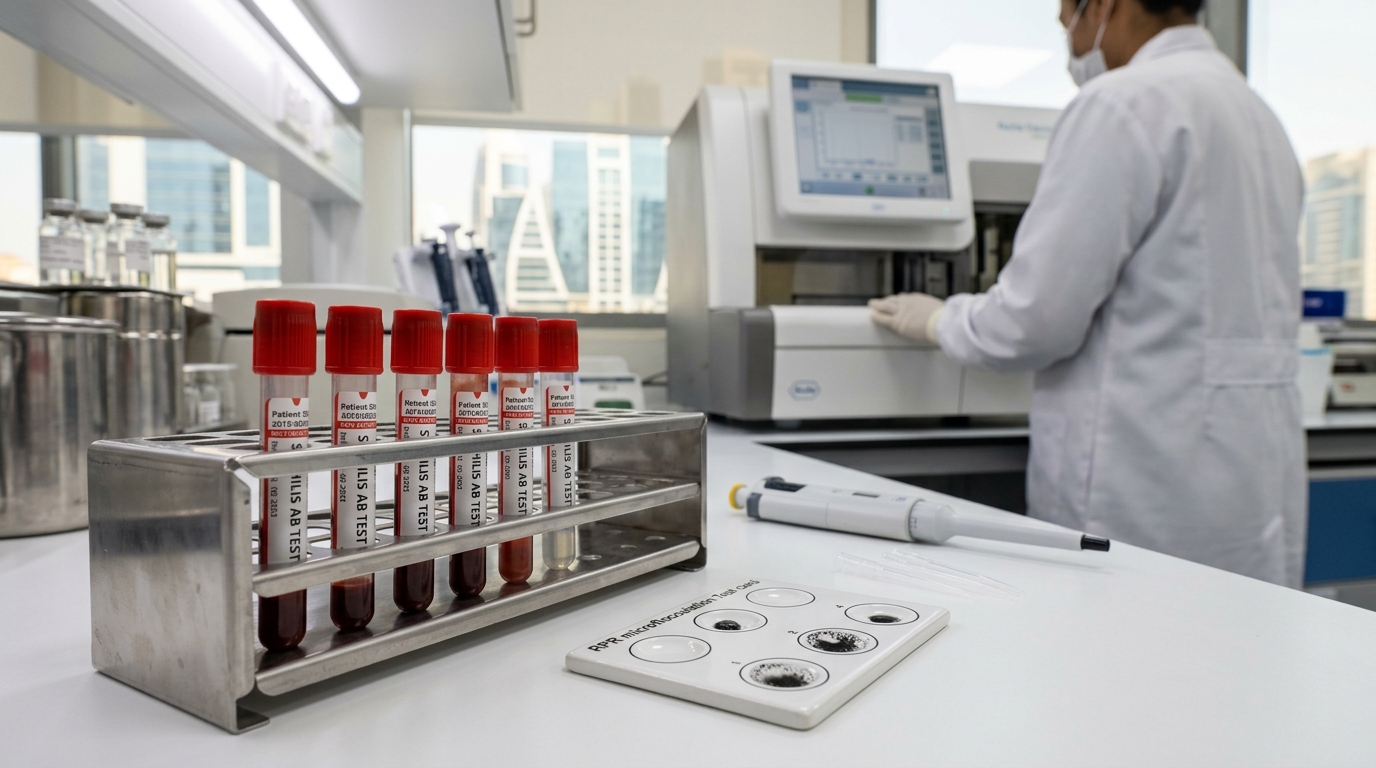
In specialized medical polyclinics and diagnostic centers across Dubai, Abu Dhabi, and the wider UAE, access to rapid, automated RPR titer quantification ensures precise clinical management. Scheduling comprehensive confidential and discrete sexual health testing packages in Dubai guarantees access to certified serological and molecular testing platforms adhering strictly to international standards.
Understanding Non-Treponemal vs Treponemal Serology
The immunological response to Treponema pallidum infection generates two distinct antibody classes, and understanding their divergence is paramount:
- Treponemal Tests (TP-PA, FTA-ABS, CLIA, Rapid Immunoassays): Detect antibodies directed specifically against structural proteins of T. pallidum. Treponemal tests are qualitative (“Reactive” vs “Non-Reactive”) and possess high sensitivity and specificity. However, in > 85%–90% of individuals, treponemal antibodies remain positive for life regardless of successful antibiotic treatment. Thus, treponemal tests cannot determine whether an infection is active or cured.
- Non-Treponemal Tests (RPR and VDRL): Detect antibodies (reagin) directed against a lipid antigen mixture containing cardiolipin, lecithin, and cholesterol. Cardiolipin antibodies are produced in response to cellular tissue destruction caused by the spirochete and from lipoidal antigens shed by the bacterium itself.
- Quantitative Titer Significance: RPR is reported as a quantitative dilution titer (e.g., 1:1, 1:4, 1:16, 1:64, 1:256). Higher titers indicate high active bacterial replication and tissue inflammation, while falling titers document therapeutic cure.
Primary Clinical Indications for Syphilis RPR Testing
International clinical guidelines from the U.S. Centers for Disease Control and Prevention (CDC), the British Association for Sexual Health and HIV (BASHH), and the Dubai Health Authority (DHA) outline clear diagnostic mandates:
| Clinical Scenario | Target Patient Population | RPR Diagnostic Role | Clinical Decision Rule |
|---|---|---|---|
| Confirmation in Reverse Algorithm | Individuals testing Reactive on automated treponemal screening (CLIA/EIA) | RPR determines disease activity and assigns baseline titer | Reactive RPR = Active syphilis requiring immediate penicillin staging; Non-Reactive RPR prompts TP-PA tie-breaker to differentiate past treated vs early primary syphilis. |
| Therapeutic Cure Monitoring | All patients treated with Benzathine Penicillin G for confirmed syphilis | Quantifies serial titer decline at 3, 6, 9, 12, and 24 months | Treatment success is formally defined as a fourfold (two-dilution) drop in titer (e.g., 1:64 falling to 1:16). |
| Detection of Syphilis Re-infection | Previously treated individuals presenting with new sexual exposure | Identifies rising titers comparing to historic baseline | A fourfold (two-dilution) increase in RPR titer (e.g., 1:4 rising to 1:16) confirms re-infection requiring repeat treatment. |
| Secondary Syphilis Rash Workup | Patients presenting with non-pruritic maculopapular rash on palms/soles, condyloma lata | RPR is virtually 100% reactive in secondary syphilis | Titers are typically high (≥ 1:32 or 1:64); rule out prozone effect if negative in suspected cases. |
| Antenatal Obstetric Booking | All pregnant women at initial prenatal visit and third trimester | Screens for maternal infection to prevent congenital syphilis | Prevents vertical transmission causing stillbirth, hydrops fetalis, neonatal bone deformities, and infant mortality. |
The Reverse Algorithm Revolution: CLIA Screening with Reflex RPR
Traditionally, laboratories screened samples with RPR and confirmed positives with a treponemal assay (“Traditional Algorithm”). However, modern high-throughput clinical laboratories worldwide have transitioned to the “Reverse Screening Algorithm”:
- Step 1 — Automated Treponemal Screening: The laboratory screens all serum specimens using an automated Chemiluminescent Immunoassay (CLIA) or EIA. If non-reactive, no further testing is indicated.
- Step 2 — Reflex Quantitative RPR: If the treponemal screen is reactive, the laboratory automatically reflex-tests the specimen with quantitative RPR. If the RPR is reactive, the diagnosis of active syphilis is confirmed, the baseline titer is established, and treatment is initiated.
- Step 3 — Discordant Resolution with TP-PA: If the treponemal screen is reactive but the RPR is non-reactive (a common finding in modern practice), a second distinct treponemal assay (Treponema pallidum Particle Agglutination – TP-PA) is performed. If TP-PA is reactive, it indicates past successfully treated syphilis or late latent syphilis. If TP-PA is non-reactive, the initial CLIA was a false-positive screen.
The Prozone Phenomenon: The False-Negative Trap
A critical technical pitfall in non-treponemal testing is the Prozone Effect:
In secondary syphilis or early latent infection with exceptionally high antibody loads (antigen-antibody excess), an overwhelming abundance of anti-cardiolipin antibodies blocks optimal lattice formation and flocculation. The undiluted serum sample appears visually negative, generating a catastrophic false-negative report in an acutely infected, highly contagious patient!
Clinical Laboratory Mitigation: When secondary syphilis is clinically suspected (classic palmar/plantar lesions, lymphadenopathy), the clinician must request “RPR with serial dilutions to rule out prozone.” Diluting the specimen 1:10, 1:100, and 1:1000 restores the zone of equivalence, producing intense flocculation and revealing titers often exceeding 1:256.
Biological False Positives (BFP) in RPR Testing
Because RPR detects non-specific anti-cardiolipin antibodies rather than treponemal antigens, biological false-positive (BFP) reactions occur in roughly 1% to 2% of the general population:
- Acute BFP (< 6 Months): Induced by acute viral infections (Epstein-Barr Virus, Hepatitis, Varicella), pregnancy, malaria, recent immunization, or extensive febrile illness. Titers are typically low (≤ 1:4).
- Chronic BFP (> 6 Months): Strongly associated with autoimmune connective tissue diseases, predominantly Systemic Lupus Erythematosus (SLE) and Antiphospholipid Syndrome (APS), as well as intravenous drug use, advanced leprosy, and chronic liver cirrhosis.
- Diagnostic Rule: Any reactive RPR must be confirmed with a specific treponemal assay (TP-PA or FTA-ABS) to verify true treponemal etiology.
Frequently Asked Questions (FAQ)
Can RPR testing be performed on Cerebrospinal Fluid (CSF) to diagnose Neurosyphilis?
No. RPR is officially contraindicated on cerebrospinal fluid. The Venereal Disease Research Laboratory (VDRL) test is the only non-treponemal assay approved for CSF testing. A reactive CSF-VDRL confirms neurosyphilis, although a non-reactive result does not entirely exclude it.
What constitutes a “fourfold decline” in RPR titer?
A fourfold change represents a shift of two serial dilution doubling tubes. For example: A decline from 1:32 to 1:8 is a fourfold drop (successful treatment). A decline from 1:32 to 1:16 is only a twofold drop (incomplete response requiring ongoing monitoring). An increase from 1:4 to 1:16 is a fourfold rise (re-infection or relapse).
What does a “Serofast” state mean in syphilis?
Approximately 15% to 20% of patients successfully treated for syphilis achieve clinical cure and a fourfold titer drop, but maintain a low, persistent non-treponemal titer (typically ≤ 1:4 or 1:2) indefinitely. This “serofast” state does not indicate active infection or treatment failure and does not require repeat antibiotic treatment unless the titer rises.
Authoritative Clinical References
- Centers for Disease Control and Prevention (CDC) – Syphilis Treatment and Serologic Monitoring Guidelines
- World Health Organization (WHO) – Guidelines for the Treatment of Treponema pallidum (Syphilis)
- British Association for Sexual Health and HIV (BASHH) – United Kingdom National Guideline on the Management of Syphilis