
When is Syphilis Screening During Pregnancy Indicated? CDC Trimester Protocols, Congenital Syphilis Prevention & UAE Antenatal Guidelines
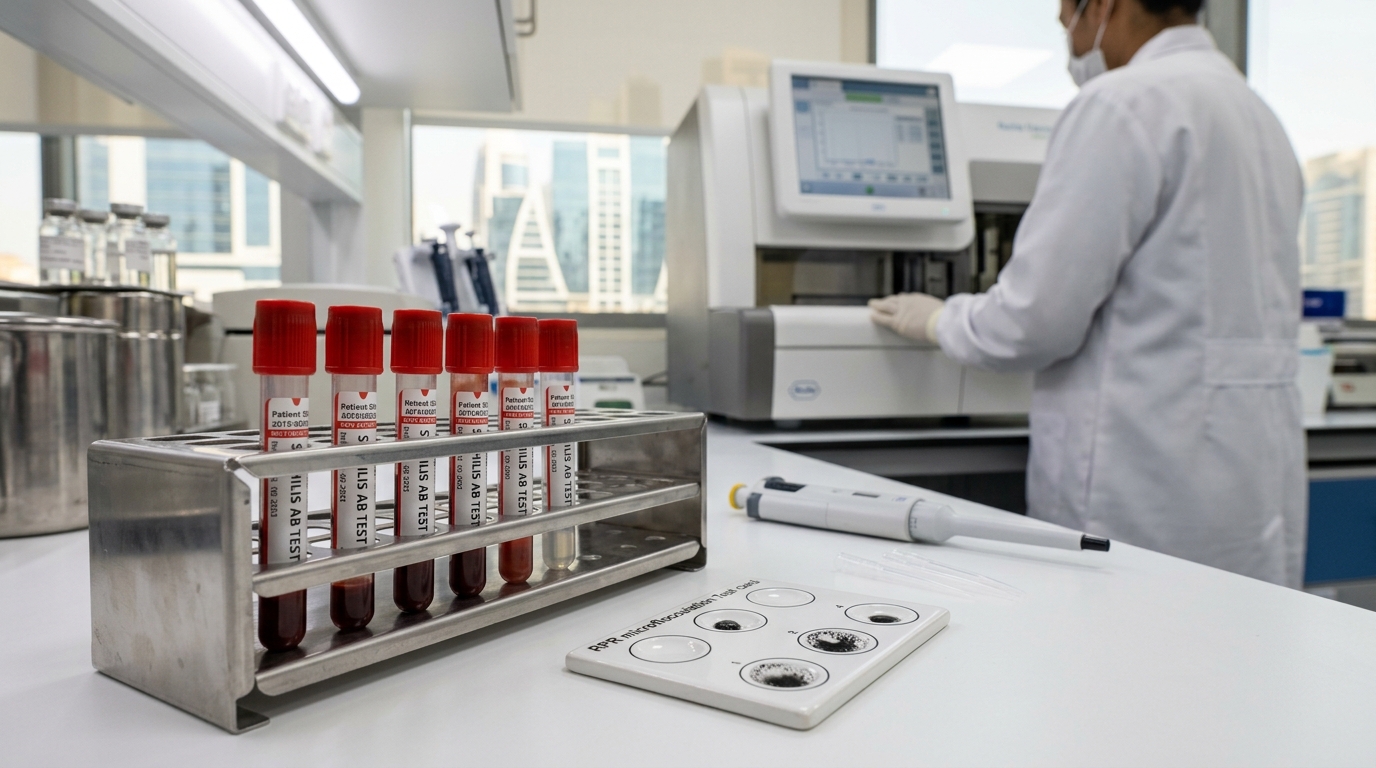
In obstetrics departments, antenatal clinics, and women’s health centers throughout Dubai, Abu Dhabi, and the wider UAE, routine serological screening safeguards maternal and neonatal life. Booking comprehensive confidential sexual health and prenatal screening packages in Dubai ensures expectant mothers receive gold-standard treponemal and non-treponemal diagnostics interpreted by licensed clinicians.
Pathophysiology of Transplacental Spirochetal Transmission
To appreciate the urgency of screening timing, clinicians must examine the transmission mechanics of Treponema pallidum across the maternal-fetal barrier:
- Direct Transplacental Invasion: Spirochetes can cross the placenta and infect the developing fetus as early as 9 to 10 weeks of gestational age. While early histological models suggested the Langhans layer provided protection prior to 16 weeks, contemporary molecular pathology confirms transplacental invasion occurs throughout all three trimesters.
- Maternal Disease Stage Correlation: Transmission risk directly correlates with maternal spirochetemia. In untreated primary or secondary maternal syphilis, the transmission rate to the fetus approaches 70% to 100%. In early latent syphilis, transmission remains high at approximately 40%, dropping to 10% in late latent disease.
- Fetal Immunological Response: The fetal immune system does not mount an inflammatory response to the spirochete until after 18 to 20 weeks of gestation, when plasma cells develop. Consequently, severe pathological manifestations—fetal anemia, hepatosplenomegaly, placentomegaly, and non-immune hydrops—predominantly manifest during the mid-to-late second and third trimesters.
The 3-Tiered Antenatal Screening Schedule
International consensus guidelines mandate a structured multi-point screening strategy to identify both pre-existing maternal infections and incident seroconversions acquired during pregnancy:
| Antenatal Milestones | Screening Cohort Mandate | Recommended Testing Modality | Clinical Objective & Rationale |
|---|---|---|---|
| First Prenatal Visit (First Trimester) | Universal (100% of all pregnant women) | Automated Treponemal CLIA/EIA or Traditional RPR | Identifies chronic latent or early active infection; enables prompt maternal cure before irreversible fetal organ injury develops. |
| 28 Weeks’ Gestation (Third Trimester) | Universal or High-Risk / Regional Mandate | Quantitative Non-Treponemal RPR / VDRL | Detects new incident infections acquired during the second trimester; guarantees treatment initiation > 30 days prior to delivery. |
| At Delivery / Postpartum Discharge | Universal in high-prevalence areas or unconfirmed charts | Quantitative RPR / VDRL + Maternal Serology | Prevents neonatal discharge of an infected infant; no mother or neonate should leave the maternity ward without documented serology. |
| Unexplained Stillbirth Workup | Mandatory for any fetal demise after 20 weeks | Maternal Quantitative RPR + Treponemal Confirmatory | Identifies undiagnosed syphilis as the cause of intrauterine fetal demise, prompting immediate maternal therapy. |
Algorithm Interpretation: Reverse vs Traditional in Pregnancy
Maternal physiological changes introduce distinct serological nuances that clinicians must navigate carefully:
- Biological False Positives (BFP) in Pregnancy: Normal pregnancy produces altered immunological states and transient polyclonal B-cell activation, yielding biological false-positive results on non-treponemal tests (RPR or VDRL) in up to 1% to 2% of pregnant women. Any reactive RPR screen in pregnancy must reflex immediately to a specific treponemal confirmatory assay (TP-PA or FTA-ABS).
- The Reverse Algorithm in Antenatal Care: When automated treponemal immunoassays (CLIA/CMIA) are used as the primary screen:
If CLIA is Reactive, reflex quantitative RPR is performed. If RPR is reactive, active syphilis is diagnosed and staged. If RPR is Non-Reactive, a second treponemal assay (TP-PA) is required. If TP-PA is reactive and the mother has no documented history of adequate prior penicillin therapy, she must be treated empirically as late latent syphilis to protect the fetus.
- Serofast State vs Reinfection: In women with documented past treated syphilis, a low stable titer (≤ 1:2 or 1:4) represents a serofast baseline. A sustained fourfold rise in titer (e.g., from 1:2 to 1:8 or 1:4 to 1:16) confirms active reinfection and mandates immediate full re-treatment.
Penicillin: The Non-Negotiable Curative Standard
Parenteral Benzathine Penicillin G is the only proven antimicrobial regimen that crosses the human placenta in concentrations sufficient to eradicate spirochetes in the fetal compartment and cure congenital infection:
- Primary, Secondary, or Early Latent Syphilis: Benzathine Penicillin G, 2.4 million units intramuscularly in a single dose. (Some protocols advocate a second dose 1 week later in pregnant patients to maintain high maternal serum levels).
- Late Latent Syphilis or Syphilis of Unknown Duration: Benzathine Penicillin G, 2.4 million units intramuscularly weekly for 3 consecutive weeks (total 7.2 million units). Doses must not exceed a 7 to 9-day interval between injections; if missed, the entire 3-week course must be restarted.
- Critical 30-Day Delivery Threshold: Maternal treatment must be fully completed at least 30 days prior to delivery to be considered adequate for the prevention and cure of congenital syphilis. Delivery occurring within 30 days of maternal therapy necessitates full diagnostic evaluation and 10 days of intravenous crystalline penicillin for the newborn.
- Penicillin Allergy Management: There is no acceptable substitute for penicillin in pregnancy. Macrolides (Azithromycin) do not cross the placenta reliably, and Doxycycline is strictly contraindicated due to fetal teratogenicity and bone growth restriction. Expectant mothers with documented penicillin allergy must undergo mandatory desensitization in an intensive care or monitored labor unit followed immediately by Benzathine Penicillin G therapy.
The Jarisch-Herxheimer Reaction in Pregnancy
Within 2 to 12 hours of the first penicillin injection, rapid lysis of treponemal spirochetes releases endotoxin-like pyrogens, triggering the Jarisch-Herxheimer reaction (fever, chills, tachycardia, uterine contractions, and transient fetal heart rate decelerations). Expectant mothers treated in the second or third trimester should be monitored in labor and delivery with continuous cardiotocography (CTG) for 24 hours. The risk of Herxheimer-induced preterm labor must never delay or prevent curative penicillin administration.
Frequently Asked Questions (FAQ)
Can a baby contract congenital syphilis if the mother was cured years before pregnancy?
No. If the mother received documented adequate penicillin therapy prior to pregnancy, has non-reactive or low stable serofast titers (e.g., ≤ 1:2), and experienced no reinfection, her fetus will not contract congenital syphilis. The newborn will passively acquire maternal IgG antibodies through the placenta, which gradually clear over 12 to 15 months of life.
What ultrasound findings indicate severe fetal syphilis?
Sonographic markers of congenital infection include hepatomegaly (most common, occurring in up to 80% of infected fetuses), placentomegaly (placental thickness > 4 cm), polyhydramnios, ascites, pericardial effusion, dilated bowel loops, and non-immune hydrops fetalis.
Why is breastfeeding allowed after maternal syphilis treatment?
Treponema pallidum is not transmitted through breast milk unless active infectious syphilitic lesions (primary chancres or secondary papules) are present directly on the mother’s breast or nipple. Once penicillin treatment has commenced and no breast lesions exist, breastfeeding is considered entirely safe.
Authoritative Clinical References
- Centers for Disease Control and Prevention (CDC) – Syphilis During Pregnancy: Clinical Guidelines and Treatment Recommendations
- American College of Obstetricians and Gynecologists (ACOG) – Practice Advisory: Universal Screening for Syphilis in Pregnancy
- World Health Organization (WHO) – Global Guidance on Criteria and Processes for Validation: Elimination of Mother-to-Child Transmission of Syphilis