
When is Type-Specific HSV IgG Indicated? Glycoprotein G Serology, False-Positive Index Traps & Pregnancy Management
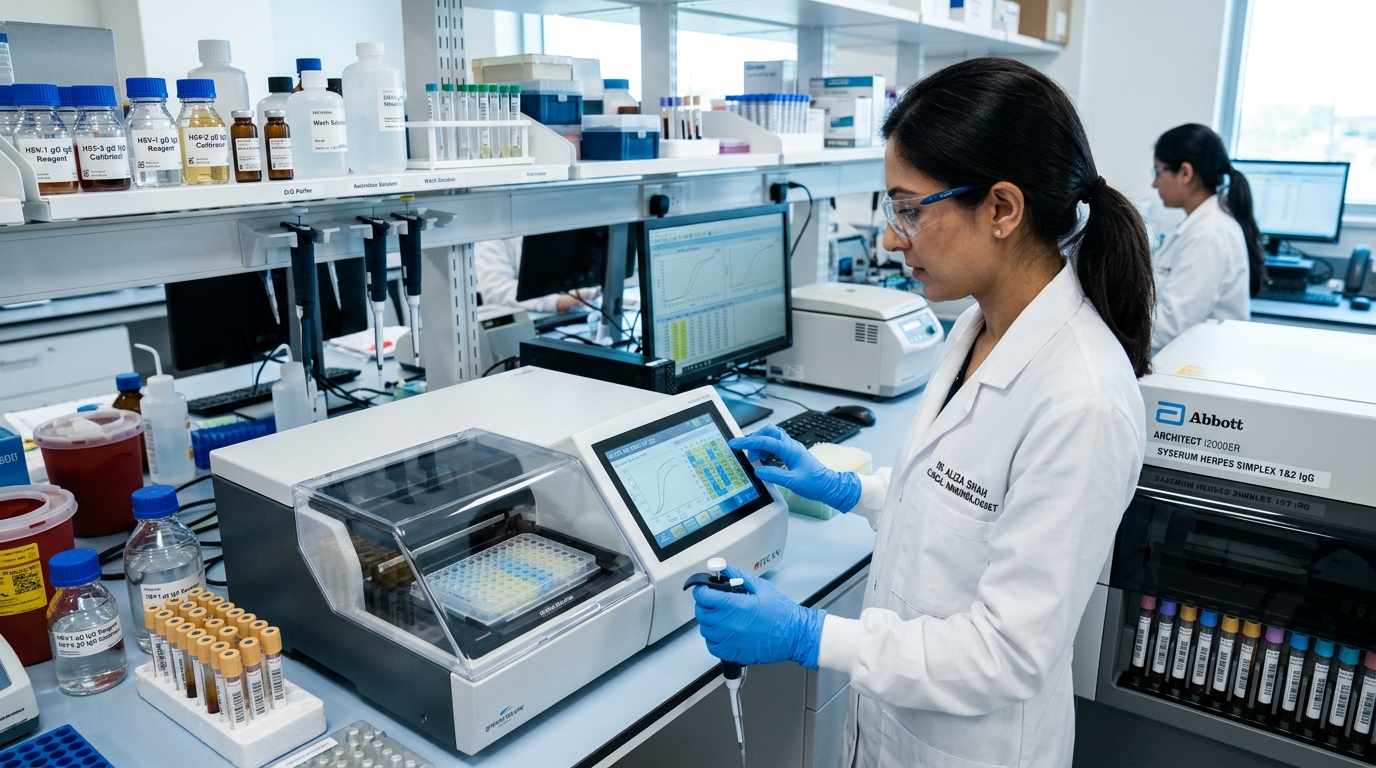
In specialized clinical centers across Dubai, Abu Dhabi, and the wider UAE, patients frequently request comprehensive blood tests following perceived sexual exposures. Understanding the nuances of antibody kinetics, window periods, and low-positive index confirmation protects patients from devastating misdiagnoses. Booking comprehensive discrete sexual health and STI testing packages in Dubai ensures access to certified chemiluminescent immunoassay (CLIA) platforms utilizing purified recombinant glycoprotein G antigens.
The Glycoprotein G Revolution: Why Crude Antigen Tests Are Obsolete
For decades, commercial laboratories used crude, whole-virus lysate preparations for herpes serology. These archaic assays suffered from catastrophic cross-reactivity because HSV-1 and HSV-2 share extensive sequence homology across greater than 80% of their structural proteins. The breakthrough came with identifying envelope glycoproteins:
- Glycoprotein G-1 (gG-1): An envelope surface protein antigenically unique to Herpes Simplex Virus Type 1. Elicits specific anti-gG-1 IgG antibodies without cross-reacting with HSV-2.
- Glycoprotein G-2 (gG-2): An envelope surface protein antigenically unique to Herpes Simplex Virus Type 2. Elicits specific anti-gG-2 IgG antibodies without cross-reacting with HSV-1.
- Regulatory Mandate: Both the CDC and the International Union against Sexually Transmitted Infections (IUSTI) state that any serologic herpes test that does not specifically detect antibodies to glycoprotein G (gG-1 and gG-2) is clinically unacceptable and must not be used in modern practice.
- IgM Testing Warning: Testing for HSV IgM is strictly contraindicated. IgM assays cross-react extensively between types, do not distinguish primary infection from recurrent reactivation, and frequently yield false-positive results.
Core Clinical Indications: When Should Type-Specific HSV IgG Be Ordered?
Type-specific serology is indicated ONLY under specific, well-defined clinical circumstances:
| Clinical Indication | Patient Cohort / Clinical Scenario | Serological Finding & Clinical Impact |
|---|---|---|
| Recurrent Atypical Symptoms with Negative Swabs | Patients with episodic genital fissures, erythema, or neuropathic tingling whose PCR swabs are repeatedly negative due to late presentation. | A positive gG-2 IgG confirms chronic HSV-2 infection, explaining symptoms and enabling daily suppressive antiviral therapy. |
| Sexually Discordant Couples Counseling | One partner has a documented history of genital herpes; the asymptomatic partner wishes to know their susceptibility status. | Identifies uninfected partner; guides daily suppressive valacyclovir for the source partner and condom use to prevent transmission. |
| Third-Trimester Pregnancy Risk Stratification | Pregnant women whose sexual partners have active or recurrent genital herpes. | Identifies seronegative mothers at catastrophic risk of acquiring primary HSV in late pregnancy; mandates third-trimester antiviral prophylaxis. |
| Clinical Diagnosis Confirmation | Patients previously diagnosed with genital herpes solely by visual clinical exam without laboratory confirmation. | Provides objective virological verification; differentiates HSV-1 from HSV-2 to guide recurrence prognosis. |
The Low-Positive Index Trap: Understanding False Positives (1.1 to 3.0 Index)
One of the most dangerous diagnostic pitfalls in modern serology is the interpretation of commercial ELISA or CLIA index values. Standard laboratory cutoffs classify any index value >1.1 as “positive.” However, extensive peer-reviewed data reveal a major vulnerability:
| HSV-2 IgG Index Value Bracket | Positive Predictive Value (PPV) | Diagnostic Reality & Action Required |
|---|---|---|
| Index 1.1 to 3.0 (Low-Positive) | Only 50% True Positive Rate | Up to 50% of results in this range are FALSE POSITIVES. Mandates a confirmatory test (Biokit HSV-2 or Western Blot) before informing the patient. |
| Index 3.1 to 5.0 (Moderate-Positive) | ~85% to 90% True Positive Rate | High probability of true infection; confirmatory testing recommended in low-risk patients. |
| Index >5.0 (High-Positive) | >99% True Positive Rate | Definitive laboratory evidence of past HSV-2 exposure and persistent latency. |
The Seroconversion Window Period: When to Test Following Exposure
Host adaptive immune responses take time to synthesize detectable titers of anti-glycoprotein G antibodies:
- 2 to 4 Weeks Post-Exposure: Only 50% of newly infected individuals develop detectable IgG titers. Testing within the first month yields frequent false-negative results.
- 6 to 8 Weeks Post-Exposure: Approximately 70% to 80% of infected individuals seroconvert.
- 12 to 16 Weeks Post-Exposure: Over 95% to 98% of individuals achieve full seroconversion. A negative type-specific IgG test performed at 12 weeks post-exposure provides definitive reassurance that transmission did not occur.
Comprehensive Clinical Action Plan for Confirmed Seropositive Patients
When a patient tests confirmed positive for HSV-2 IgG antibodies, clinicians must provide evidence-based counseling:
- Education on Asymptomatic Shedding: Inform the patient that asymptomatic viral shedding occurs on 10% to 20% of days, and transmission can occur without visible sores.
- Symptom Recognition Training: Educate the patient on recognizing subtle prodromes (sacral neuralgia, tingling, localized itchiness) and atypical lesions (minor papercut-like fissures, folliculitis-like bumps).
- Daily Suppressive Antiviral Therapy: For patients with frequent outbreaks or who wish to protect an uninfected partner, prescribe Valacyclovir 500 mg once daily, reducing transmission risk by greater than 50%.
- Pregnancy Planning: Reassure female patients that having recurrent HSV-2 carries a <1% risk of neonatal transmission, compared to a 30%–50% risk for primary infection acquired in late pregnancy. Routine prophylaxis with oral acyclovir or valacyclovir begins at 36 weeks gestation.
Frequently Asked Questions (FAQ)
Does a positive HSV-1 IgG test mean I have genital herpes?
No. Over 60% of adults worldwide test positive for HSV-1 IgG due to childhood oral exposure (cold sores). Because IgG blood tests cannot determine the anatomical site of infection, a positive HSV-1 blood test in an asymptomatic patient cannot be assumed to represent genital herpes.
Why do guidelines advise against screening everyone for herpes?
Because false-positive rates are high in low-risk populations, there is no curative vaccine, and a positive diagnosis causes profound psychological anxiety, relationship distress, and social stigma without providing actionable clinical benefit to completely asymptomatic individuals.
Can antiviral medication delay IgG seroconversion?
Yes. Initiating high-dose antiviral chemotherapy (valacyclovir or acyclovir) immediately within the first 24 to 48 hours of primary infection can blunt viral replication and delay humoral seroconversion, extending the required window period to 6 months in rare cases.
Scientific References & Authoritative Clinical Guidelines
- Centers for Disease Control and Prevention (CDC). Sexually Transmitted Infections Treatment Guidelines: Serologic Diagnosis of Herpes Simplex Virus. MMWR, 2024.
- U.S. Preventive Services Task Force (USPSTF). Screening for Genital Herpes: Recommendation Statement. JAMA, 2024 Reaffirmation.
- Dubai Health Authority (DHA). Standards for Laboratory Serological Testing and Sexually Transmitted Infection Clinical Protocols. UAE Health Regulations, 2024.